A Modern Approach to a Traditional Technique Continued (Establishing a Background Color)

October 8, 2009

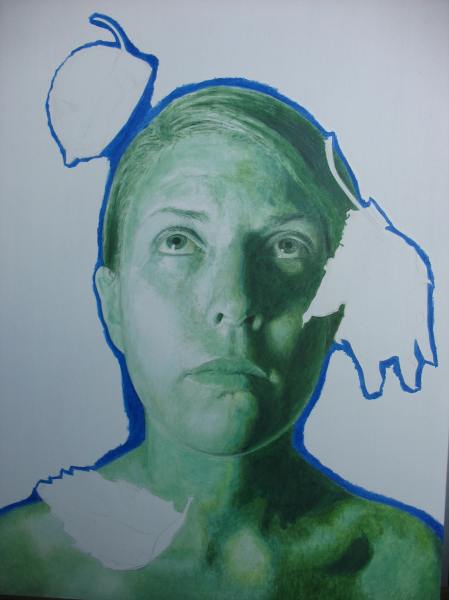
As I now have realized the general light and shadow masses for my main subject, I am ready to establish a background color.  This is an extremely important decision.  I want to choose a color that will relate to my portrait tonally and chromatically.  When it comes to color, I leave nothing to chance. My approach is very methodical.  I am aware of how one layer will modify the color of a previous layer.  In a sense, I am thinking backwards.  I knew that some of the greens in the underpainting would be evident even in the final layers, and, because green is essentially a cool color, I decided that a compatible background color would be a deep blue.  I wanted a blue that would be extremely rich and vibrant, like so many Flemish paintings of the early Renaissance.  A commonly used color of that time was Lapis Lazuli, made from precious minerals.  The color is no longer available today, but I discovered a close substitute.  Many of the colors that I am using in this painting are not commercially produced.  They are sold in a small store in Brooklyn, run by an eccentric man named Robert Doak.  He is a purveyor of historical pigments and materials, and one can walk into his store and feel like they’ve entered another century.  In the store, he has large jars of powdered pigments as well as synthetic brushes, homemade resins, mediums, varnishes, and tubes of paint.  If you go there though, be sure that you have a lot of time on your hands, because he will talk your ear off.  His website is www.robertdoakart.com.

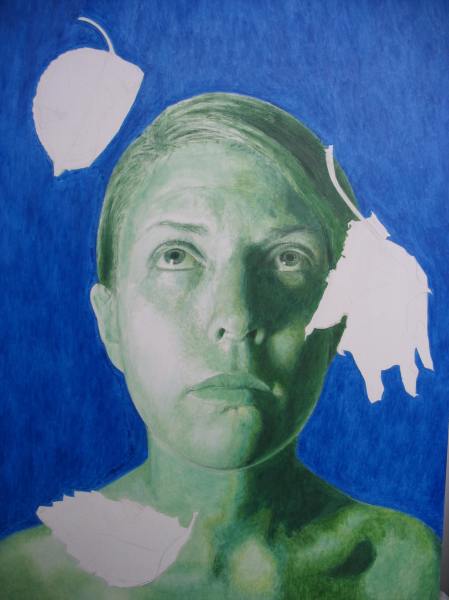
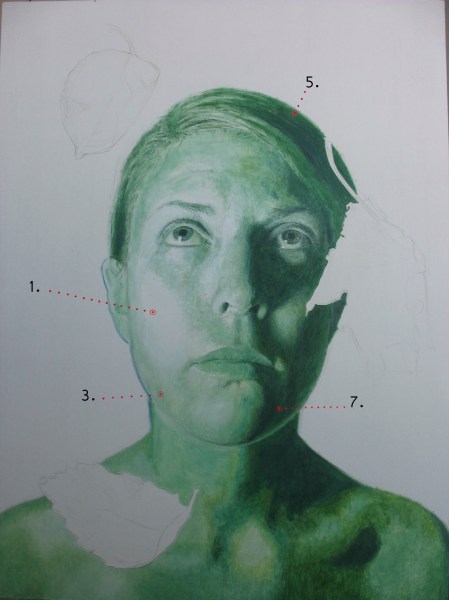
For the initial layer I used a combination of two of the blues he sells — Chromatic Blue and Wellington Blue.  Both of these colors are very saturated and creamy in consistency.  I mixed them together in equal portions with a palette knife, and then with a # 4 round brush, I proceeded to apply the color around the contours of my subject as shown in example A.  I concentrated on brushing the color out evenly, eliminating texture and opacity.  Because I am applying it directly over the white ground, the color will appear lighter and more luminous than it would if applied over a toned ground.  I continued to work the color away from the contours of my subject towards the outer edges of my panel as shown in example B.  These blues are naturally transparent colors, and will appear streaky at first, but they will be evened out with additional layers.  Once I established the background, I could see that some of the values in my subject needed adjusting.

Example A
IMG_2327

Example B

IMG_2329


A Modern Approach to a Traditional Technique

October 5, 2009

I have expressed the importance of “seeing” value before color in previous blogs.  Now, I would like to reveal how this concept can be used as an under-painting and develop, through the process of glazes, into a full color painting. I have documented the progress of one of my original works to demonstrate this point.

Before I begin, it is important for me to stress that the techniques being used here are based on tradition, not confined to it.  I have taken some liberties (only after thorough study of the more traditional approaches) to realize my vision for this particular image.  Art should never be limited to one technique or another; it should always be evolving.  Tradition is a great way to learn a particular style or approach, but it is important for an artist to mold those ideologies into his own practice otherwise his work will become stagnant.

I am using several different techniques in this painting.  The first technique is a modified grisaille which will be glazed over.  This is referred to as an in-direct painting method.  The second approach is a direct painting method, painted directly onto the white ground in full color.  Each approach will create different chromatic effects.

In the Northern Renaissance prior to the fourteenth century, artist’s worked primarily in egg tempera.  Most of the painted subjects were religious scenes composed of many figures.  Flesh tones were underpainted in green, which added a certain degree of brilliance to the final colors.  The selection of pigments at that time were much more limited. Terre Verte was a natural green pigment made from the earth and commonly used for that reason.  It is still available today but very transparent, making it hard to work with.  I have substituted this color with Viridian Green which has a little bit more body.  In addition to Viridian Green, I will be using Ivory Black, and Flake White to create a green grisaille.

Below are two scales.  One is made up of greys only, and the other is made up of tints and shades of green.  They are identical in value.  The green scale is simulated to look like paint mixtures of the three colors mentioned above.  Value #5 is closest to a true Viridian Green without the addition of black or white.  It is slightly darker than a mid-tone.  Notice how the lighter green values appear to be cooler (leaning more towards a blue-green) and the darker values appear to be warmer (leaning more towards a yellow-green). This is true when the colors are mixed directly on the palette as well.  White will make the green more opaque and eliminate some of the natural yellow influence in the pigment, whereas black will do the opposite, making the pigment appear warmer.  This display will actually give the grisaille a warm/cool appearance without any additional colors.

grey scale copy copy copy copy copy copy

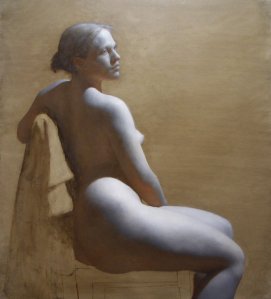
Once I completely filled in my shadow masses, I began to work into my light masses.  I am now looking for the subtle variations of tone, particularly half tones (the area where shadow transitions into light).  I decided not to apply any tone on the left side of her cheek.  This area will be glazed over with translucent layers of paint, which will give more luminosity to the final colors.

kate1 for blog


Reflective Color

October 1, 2009

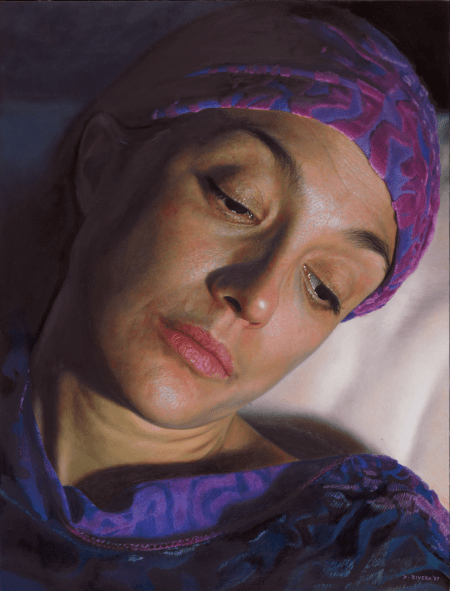
Below is a painting of mine which demonstrates the use of reflective color, one of many crucial elements in color composition.  Often students are curious to see how I utilize the exercises that I give in class in my personal work.  Teaching allows me to stop and analyze the very process by which I arrive at a finished work of art.  It forces me to be more aware of the journeys that I undergo in the studio, thus helping me to formulate real step by step approaches to use as exercises in the classroom.  My paintings are a culmination of hundreds of hours of work and they relate very closely to everything that I discuss in this blog.

copy copy 

 “Gypsy Dreamer” David Rivera, 2007

Though it is not really obvious in this reproduction, violet glazes were worked into the shadow masses on the side of the face and nose to reflect the color of the scarf.  This glaze was added in the final stages of the painting, and without it, the painting didn’t have the warm unification of light that I wanted.  It is quite amazing how simple things like that can tie everything together.


Color Contrast vs. Unified Color

September 30, 2009

There is a far greater array of possibilities to achieve a visual impact in a painting with color than there is with only value, though if both are used together, the result will be captivating. In previous blogs I discussed the importance of value emphasis to create a focal point. The same rule applies to color. Colors, like music notes, can be harmonious, bold, dramatic, subtle, and complex.  If a painter knows how to play these “color” notes to their fullest potential, he or she can infuse his work with the same majestic qualities that are found in a musical masterpiece.  To achieve this however, he must understand that color needs to be balanced in a composition. 

There are two distinct entities in the orchestration of color; color contrast and unified color.  It is said that every variation of color can be achieved with the three primary colors (red, yellow and blue).  This is only true to an extent. It is a fine palette to use for the purpose of learning how to mix the secondary colors, (purple, orange and green) however, if the artist’s goal is to mimic, as closely as his capabilities will allow him, the infinite range of colors that are found in nature, the mixtures of the three primaries will never suffice.

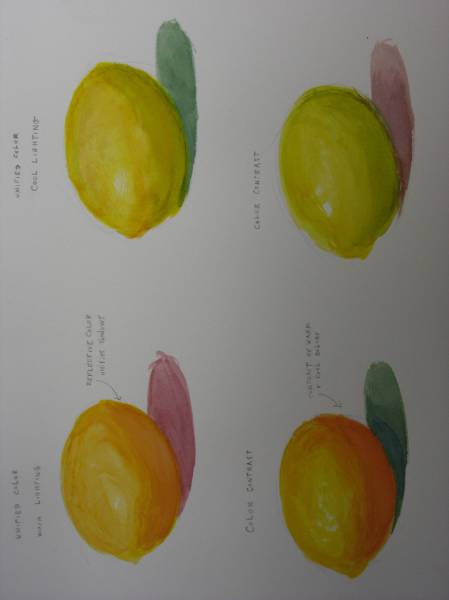
In the previous blog I wrote about observing the reflective colors that are often found in shadows.  Below is a simple demonstration displaying how that can be used to vary or unify particular colors.  All of the color variations occur in the form shadow (shadow on the object) or the cast shadow (shadow beneath the object).  The effect of the light differs quite drastically based soley upon the color combinations within the shadows of each image.  In the top two images, the form shadow and cast shadow are similar in color which creates the illusion of a unified light.  The image to the left demonstrates a “warm” lighting effect, using mixtures of yellow and red to create an orange shadow mass.  The form shadow appears to have more of a yellow influence of color, and the cast shadow has more of a red influence of color. They could be labeled as yellow-orange and red-orange.  The variations occur with the influence of the two primaries, yellow and red, which, incidently are both used to mix orange.  These two variations are referred to as tertiary colors.  The top image on the right demonstrates the same effect using a yellow-green form shadow and blue-green cast shadow.

The two images on the bottom demonstrate a very different approach which aims to create a vibrant contrast between the form shadow and cast shadow.  On the left, orange is used in the form shadow and a bluish-green is used in the cast shadow. This creates a strong warm/cool color contrast which (in opposition to the top two images) distinctly separates the object from the cast shadow. On the right image the same rule applies, pairing a yellow-green form shadow with a reddish-orange cast shadow.

IMG_2570

A well-balanced composition consists of portions of unified color as well as color contrasts.  A painting orchestrated with nothing but harsh color contrasts, becomes chaotic and overwhelming to look at.  The viewers eyes dont know where to focus, and soon he or she looses interest. The same is true of a painting composed with colors that have very little variation.  Though the ladder is perhaps less unappealing to view, the introduction of a select few vibrant colors in an otherwise chromatically unified painting can create a beautiful intensity.


Understanding color

September 28, 2009

What is color theory and how does it apply to art?  The answer to this question is very controversial as there are numerous schools of thought on the “right” way to approach color.  The bottom line is that every artist interprets color differently and the choices that he or she makes in choosing one color over another are based largely on aesthetics, and perception but also physchological intuition.  This is why color serves more than one purpose in art and why so many color theories have developed over the years.  I will only touch briefly on color theory in this blog, as I am more concerned (for the purposes of teaching) with it’s perceptual applications to painting rather than it’s phsychological ramifications.  For those interested in delving further into this topic, there are many great books devoted to it.

Color is apparent only where there is light.  Without light, color would not exist.  In previous blogs I wrote of the importance of value contrasts to describe form.  Take that same concept and apply it to a colored object. If one were to take a red ball, for example, and shine a spotlight on it, a light side and shadow side would be apparent.  The true red color however, would only appear in the transition somewhere between the shadow and highlight.  This is known as the local color.  In a tonal representation this area would be a mid-tone. The highlight would be washed out and shift in value.  In painting, the simplest way to achieve this lighter variation would be to add white to the red body of color.  This would be considered a tint of the red.  To create the darker variation of shadow, black would be the most obvious choice.  This would be considered a shade.  This type of painting would be similar to a standard grisaille (with the exception of one additional color) and, though tonally balanced, it would still fail to accentuate the lighting effect. Color contrasts are needed to mimic the enchanting qualities of light and atmosphere that are unattainable with only value.

Different light sources will influence the appearance of colors.  If one were to take an incandescent light and shine it on a red ball, the light side would appear to be somewhat orange.  That is because the nature of incandescent light is very yellow.  Take that same red ball, and put it outside on an over-cast day, and the light side would appear to be more of a violet.  This occurs because natural light in contrast to incandescent light has a much “cooler” appearance which leads me to my next point; all colors are relative to their environment.  That is why there is no one formula to mixing colors.  Every portrait, figure, still life and landscape will call upon different color mixtures based upon the way that they are lit and their surrounding environment.

Shadows are key in accentuating the illusion of light.  Rarely will shadows be absent of  light.  If that were the case they’d be completely black.  On the contrary, they reflect many of the colors in their environment.  That is because ambient light reflects off of other objects and gets “absorbed” by the shadow.  When this takes place it is referred to as reflective light.  To demonstrate this phenomenon, take an egg and place it on a red table cloth.  Shine a spotlight on top allowing the shadow to fall along the bottom half.  You will notice that the shadow absorbs the reflectivity of  the red cloth.  Now place the egg on a blue tablecloth and observe the changes.  What happens in the non-shadow portion of the egg is less influenced by the environmental changes.  That is because the rays of the direct light or primary light source overpower the environmental changes.

Painters who understand how the nature of light effects color have unlimited possibilities for invention.  They can make choices to enhance the reality that is presented to them, or even create an imagined environment in their paintings that portray all of the magical qualities that light offers.


Tonal Painting

September 25, 2009

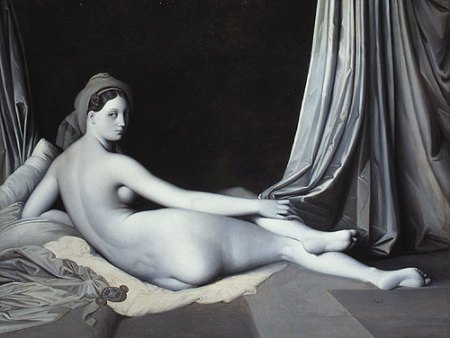
In addition to classical grisaille painting, which is soley prohibited to the use of  black and white paint, many artist’s like to introduce neutral colors to their palette to create warm and cool contrasts.  Below are some prime examples of classic grisaille painting as well as some limited palette painting.

odalisque

“Odalisque”, Jean-Auguste-Dominique Ingres, 1824

 keith chuck close

“Keith”, Chuck Close, 1970

 LaRock-AnneMarie

“Ann Marie”, Joshua LaRock, 2008


Seeing Values Before Color

September 22, 2009

There are many schools of thought on this topic. The best way for me to explain color is to begin with value. As a painter, learning how to see a color’s appropriate value and translate that into a tonally and chromatically balanced painting is the ultimate goal. That can be very difficult for the beginning painter as there are so many choices of colors and without a specific approach to simplifying those choices their paintings can easily loose coherency. The way that I teach painting is built upon the same principles of drawing. This allows for a very natural progression into painting, as it is, essentially, an extension of drawing.

Think about the way that certain colors would appear in a black and white photograph.  A yellow would appear as a light grey; a red would be close to a mid-tone grey, and a green would be yet significantly darker.  All colors have a corresponding “value”.  In painting, every type of grey can be achieved by mixing portions of black and white together.

Many artist’s use this technique to serve as an underpainting which will eventually be glazed over in color.  This works extremely well for the beginning painter as it allows for him or her to simplify the painting process into two stages — value first, then color.  Establishing the values first will influence the painting in it’s entirety.  Colors are added on top as translucent washes and are meant to enhance, rather than drastically change the tonal underpainting.  The technique is called grisaille which is a french word, meaning grey tones.

In the nineteenth century students of the ecole des beaux-arts, were only allowed to paint in color, once they’d mastered painting in grisaille.  Often plaster casts were set up as props with strong spot lights so that students could really analyze the play of light and shadow on forms without color.


Value Transitions

September 17, 2009

Sorry for my lapse in adding new content.  I’ve been busy with teaching workshops and making art, including several commissions, but now I’m back on track!

In the previous lesson I wrote about the importance of value contrast over lines (at least in the final stages of a drawing) to create the illusion of form. With that in mind, when rendering form in a drawing or painting, think about how the edges of that form are turning. The gradation from light to dark will describe the way light falls upon the surface of a form.  This gradation is referred to as the “turning” of form.  A simple form, such as a sphere would have a relatively gradual turning.  A cylinder would be more abrupt, and a cone would vary from top to bottom.  In observational drawing think not only about the shape of an object, but also what happens within it’s boundaries.  Observing the value transitions will enable you to understand the sculptural qualities of form. 

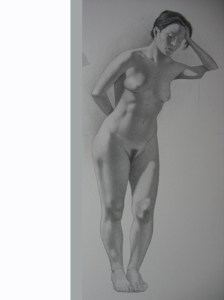
When working with the figure, there is a complex structure of underlying forms.  However, if you examine each part of the human body, you’ll notice that more general, simplified shapes can be found; the head is an oval, the arms and legs are tapering cylinders, etc.  Each part has different angles, planes, and turnings, and thus, different gradations of light to dark. Below is a 3 step demonstration of how to approach a figurative study by first delineating the general shadow shapes, and then working in the appropriate value transitions.

figure study 1

figure study 2

figure study 3


Seeing Value Instead of Line

August 11, 2009

From a very early age, we develop perceptions of how things are “supposed” to look, and, as children, we create symbols to illustrate these visual perceptions. Common subjects include people, faces, trees, and houses. Each attempt is exactly the same; people, for example, are depicted with a circular head, two dots for the eyes and nose, and a single line for the mouth. Other symbols are used to depict the limbs, hands, feet, etc. Only when we train ourselves to really look at these subjects, do we learn how to actually “see” what is there.

One very common mis-conception is that bold lines must be used to distinguish the separation between object and background.  It’s not that lines don’t play a significant role in the drawing process, but they should be used sensitively and selectively.  If they are over-used, they will flatten out the appearance of form.

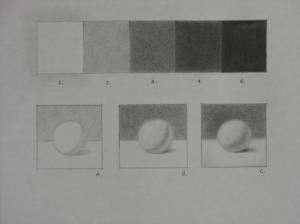
To create a realistic drawing, one must first become accustomed to seeing value instead of line.  The illustration below displays a very simple grey scale, and a demonstration of it’s proper uses in a basic tonal rendering. Square #1 is achieved simply by leaving the white of the paper.  Shading was added around the edges to demonstrate that a light area can only stand out if it’s surrounded by a darker value.  Square #3 is a mid-tone, (the value that falls between the lightest light, and the darkest dark) and square #5 is the darkest value that could be achieved with a pencil.  Values 2 and 4 were added last and fall half-way between the values of the squares bordering them.  Keep in mind that this is a very simplified grey scale — obviously the amount of greys that the human eye detects is far greater than the range displayed here. 

When applying these values to a representational drawing, they should, at first,  be simplified as much as possible.  Example A only uses values 1 and 2 and yet there is still enough range to show where the light and shadow falls.  Example B introduces value #3 which brings out a little more form.  Example C is where values 4 and 5 get added, and more shading transitions become apparent.  Notice that, as  more values get added to this drawing, the lines become more obscure and eventually they are eliminated all together.

IMG_2533


A Painting with Musical Rhythym

August 7, 2009

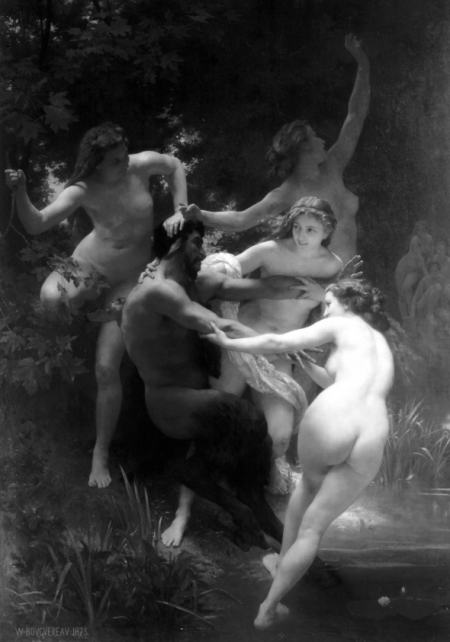
Below is a painting by a pioneer of the “academic art” movement, who, unfortunately, was also one of the most criticized artists of the late 20th century. If any painting can be compared to a classical piece of music this would certainly be a worthy choice. The way that the shapes flow into one another is an exquisite example of rhythmic energy, which I wrote about in my previous blog.

The artist is William Adolphe Bouguereau and this is only one of many masterpieces that he produced.  It is simply breath-taking to see an original; to see the layers of his paint mimic so perfectly the delicate, palpable qualities of flesh.  No other artist, in my opinion, had such a sensitivity to translating the human form into paint as Bouguereau did.  But what really sets him apart from his contemporaries is not simply his mastery of realism, but also of composition.

This particular example demonstrates how value emphasis can be used as a way of moving the viewers eye throughout the picture plane; similarly to the way a musician leads their audience through his or her performance.  The figure in the foreground is most prominent due to her light value.  This is further emphasized by the dark contrast of the water in the lower right corner.  The curve of her torso and positioning of her arm draws the viewers eye into the center of  the painting.  The movement continues to flow into the arm of the saytr and back further into the figure in the upper left corner.  The juxtaposing of each figure and the methodical use of value patterns in this painting, profoundly demonstrates how musical rhythms can be infused into a visual composition.

musical rythyms

Adolphe-William Bouguereau, Nymphs and Saytr, 1873