Creating a Balanced Composition

August 5, 2009

Composing a drawing or painting has many similarities to composing a musical arrangement. In music there is a structured hierarchy of sound – each instrument serves a purpose, distinctive in it’s part, and yet all the instruments strive to be united as a whole. The notes rise and fall (some are melodic, some are rhythmic, some are high and some are even demanding) creating an energetic flow of sound. These patterns of rhythmic energy can be found in a visual composition as well. The energy is translated into lines, values, shapes, colors and edges instead of sounds.

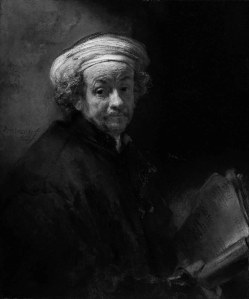
The example below is a painting by Rembrandt Van Rijn, and demonstrates a classical approach to composing a portrait using value emphasis.  The focal point is obviously the face which has the highest degree of contrasting values.  Because the background and surrounding areas are so dark, they seem to recede into an inky blackness and become obscure to the viewer. Just using value, the artist has managed to compose a painting with a distinctive focal point.
black & white rembrandt

Rembrandt Van Rijn, Self-portrait as the Apostle Paul

There are many more great examples that I’d like to post but I’ll do that in future blogs.


The Secret to Realistic Draftsmanship

July 29, 2009

Learning how to draw demands discipline, patience and a love for the process. Understanding how to re-invent what you see in a three dimensional reality onto a two dimensional surface demands a thorough understanding of your materials. As with any skill, practice is the most important factor in achieving a desired goal. Put simply, to draw well, you must stay focused!

There are many rules that apply to creating a realistic representation of form and space in a drawing.  These are techniques that were taught in art schools before the hype of  modernism, and abstract expressionism took over.  They are the techniques that apply to “academic art” and were most practiced in the late nineteenth century.

The first rule involves the use of value contrast.  Values (the range from light to dark) should be thought of as the fundamental building blocks in a representational work of art. Without a variation of light and dark, or light and shadow the illusuion of form would cease to exist. When used with purpose, value contrast can enhance not only the illusuion of form, but also the composition. Areas that have a high contrast of value in comparison to areas that have a low contrast will automatically become a point of focus or focal point.  This play of drastic light-and-dark contrast can be thought of as value emphasis.


Concept vs. Technique

July 21, 2009

The word “technique” is used frequently in art schools but seldom taught, leaving students with the inability to develop that aspect of their art work. There are an infinite number of techniques that can be learned, all of which demonstrate a different realm of artistic expression.  To me, the word “technique” describes the artist’s individual voice, and serves his or her need to comunicate a specific idea to the viewer. In other words, it is a language developed by the personal aesthetics of each individual artist.

An artistic concept is unattainable without understanding what technique is needed to support that concept.  By the same token, a superb technique can’t exist without adhering to a specific vision. 

My advice to young artists is to look at as much art as possible.  See what is out there.  See what artists inspire you and learn as much about those artists as you can.  I’ve developed my artistic language by studying the works of masters whom I admire and utilizing their techniques to enhance my vision.  I teach many of these techniques to my students as exercises but encourage them to search for their own sources of inspiration.  What I offer in class is technical.  The real concepts come from experiencing life.


Hello world!

July 17, 2009

Welcome to WordPress.com. This is your first post. Edit or delete it and start blogging!